Letter from Chile Number Two
21 October 2006
Well, we finally had our first misadventure. We spent some time trying to figure out where we went wrong, and finally chalked it up to some combination of insufficient information, a couple of bad decisions, and some just plain old bad luck.
Here are some parameters to make sense of this: I had a week off at the university, and we needed to leave Chile in order to satisfy our visa requirements. Macchu Pichu was too far in either time (bus) or money (plane.) It was too late to get reasonably priced airline tickets from Santiago to Mendoza, a popular Argentinian city across the Andes from Santiago. But John really wanted to ski, so we decided to ski at the Argentinian ski area just over the border, which is on the road from Santiago to Mendoza. (This is the only route between Chile and Argentina that is kept open in the winter.) The name of the ski area is Los Penitentes, so-named for the rock formation looking down on the area that resembles a line of monks.
Buses are the travel mode of choice in Chile. The roundtrip airfare from La Serena to Santiago is about $300. The bus ride is 6 or 7 hours each way, and the roundtrip fare is about $40 for semi-cama (partially reclining seats) or up to twice that for first-class (salon-cama, supposedly fully reclining, complete with steward and snacks). There is no train service except for one tiny stretch south of Santiago. There are four different bus terminals in Santiago. The one we came to know (Terminal Alameda) has three stories, a food court, many shops, a hotel, a car rental, and more ticket windows than the airport. Not your basic Greyhound.
The original plan was to take a nighttime first-class bus from La Serena to Santiago on a Tuesday night, and then pick up a bus from Santiago to Mendoza that would drop us at the ski area. And actually, that plan would have worked. Unfortunately all the nighttime first-class buses were booked because of the holiday, so we took one at 8:00 the next morning. There was also one that left at 5:00 a.m. that we did not choose; that turned out to be a mistake, because when we arrived at the Santiago terminal at about 3:00, all of the buses for Mendoza for that day had already left. (I had been unable to find bus schedules on the web. Note that I am also leaving out the half hour we lost by getting lost changing bus terminals that were only one block apart. We turned the wrong direction.) Perhaps we should have stayed the night and just taken the bus the next day, but John hated to miss one day of skiing out of three, and it was his birthday. We did find one woman who could arrange a shuttle for us at the price of about $120 one way (as opposed to about $30 for a bus) leaving at 4:00.
Our guide-book said that you could take a colectivo taxi to Mendoza. Colectivos are great; they are constantly whizzing around La Serena. They are basically shared taxis with set routes. They are more expensive than a bus, but a lot less expensive than a regular taxi. So after we determined that we had missed all the buses for that day, rather than wait for the next morning, we tried to find a colectivo. There were none. All we found were regular taxis. One taxidriver offered to take us to Los Penitentes for $140; John mentioned the lady’s $120 fare, and he agreed to that. So we took off.
The taxidriver was older, and did seem rather confused. We had showed him the map, and made it clear that the ski area was in Argentina, but it seemed as though he was trying to talk us into going instead to El Portillo, the famous (and very expensive) ski area on the Chilean side of the border. But we kept telling him no, we had reservations at Los Penitentes. However, John ended up paying the road tolls, and as we crossed the Argentinian border, we discovered that the taxidriver had no Argentinian car insurance, and he wasn’t allowed in without it. So we stopped, and John spent another $35 on 30 days of Argentinian car insurance. (Note that it is now 3 hours from Santiago, high in the Andes, and cold and dark. No turning back now.) The driver also stopped at another border checkpoint and picked up a couple of forms.
Finally we are dropped in the dark and cold at the ski area. We do indeed find our hosteria, and we are warmly welcomed by the assortment of young people who work there. It’s not the cleanest place I’ve ever seen, but after all it is a ski lodge right at the bottom of the slopes. After some language difficulties we discover that they serve dinner from 9:00 to 11:00 pm, and it is only 8:45 or so (and we are starving). So we put out suitcases in our room, talk to folks in the bar for a few minutes, and finally sit down to dinner.
Before we even have a chance to find out what they’re serving, one of the guests (Daniel, a young engineer from Uruguay, who spoke perfect English) comes in and says that a policeman is looking for us. We thought it was a joke, but no, it’s the Argentinian border police. Apparently the taxi driver (and ourselves) had entered the country illegally. Daniel explains that we are to bring our suitcases, because we probably will not be allowed to come back. At this point if we hadn’t had both the employees and guests helping us to explain, we would have been in trouble. The policeman was convinced we were guilty, and our Spanish was NOT up to the task of explaining that the taxi driver had lied, and that it was NOT true that we had told him we were going to El Portillo, and then when we had gotten to El Portillo, had changed our minds and told him to take us across the border to Los Penitentes. Luckily we had reservations at this hosteria, and the manager (Vanina) vouched for us. We were also very grateful for Daniel, whose English was better than any of the staff’s, and who intervened for us quite actively.
So we climbed back in the taxi with the driver and the policeman, and drove back 20 minutes to the border. (Max, one of the workers, tried to come with us to translate, but they wouldn’t let him.) Luckily, thanks to Daniel, at this point the policeman seems reasonably convinced that it is the taxi driver who is in trouble, not us. We spent perhaps an hour waiting around for the jefe to pass judgment. Finally, the (now friendly to the point of trying to be chatty) policeman keeps muttering about the dilemma of getting us back to Los Penitentes when it is illegal for this driver to enter the country. Finally we all climb back in the cab – policeman included – and we are driven back to the hosteria at almost 11:00, where we are fussed over by both staff and guests. We don’t know what happened to the taxi driver. We do think he was confused about how to cross the border, but we also know that he lied and tried to blame it on us. So we don't feel too sorry for him.
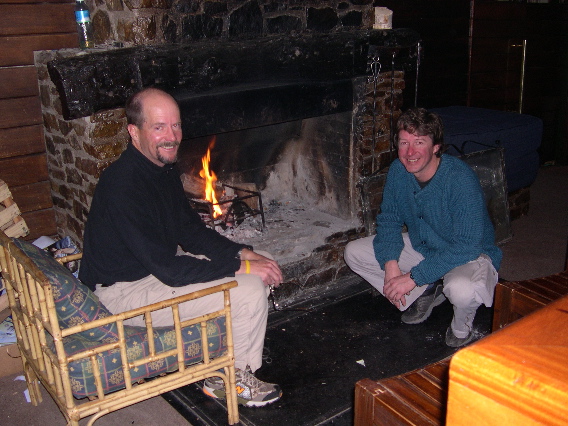
John and Daniel near the end of our stay, when everything was more relaxed. Note the skiing sunburns.
I’d like to say that everything went smoothly after that, but that would ignore the fact that we seemed to have only a trickle of water in our bathroom which vanished to nothing by the middle of the night. And the fact that it turned out that they took only cash for the ski rentals, and there was no cash machine for hundreds of kilometers. But everything worked out, and we skiied for three days and had a lovely time. We would have changed lodgings for something a bit nicer, but everyone had been so kind to us, and it felt so family-like, that we couldn’t bear to leave.
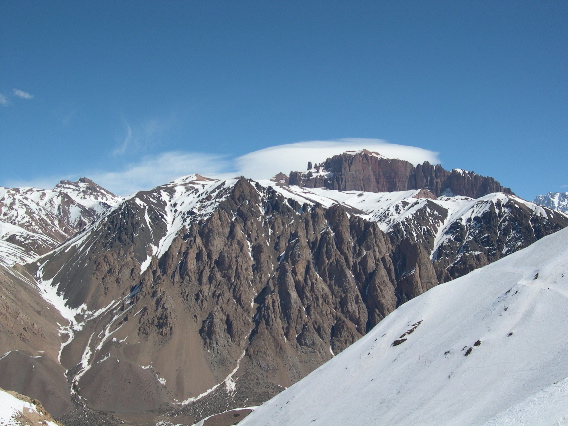
The view from the top of the highest chair. The rock formation along the top is thought to
resemble a line of monks, and gives the area its name of Los Penitentes.

Looking down the road towards Chile. This ski area sits on the side of the one road that stays open
between Chile and Argentina during the winter. Needless to say, there was a lot of truck traffic.
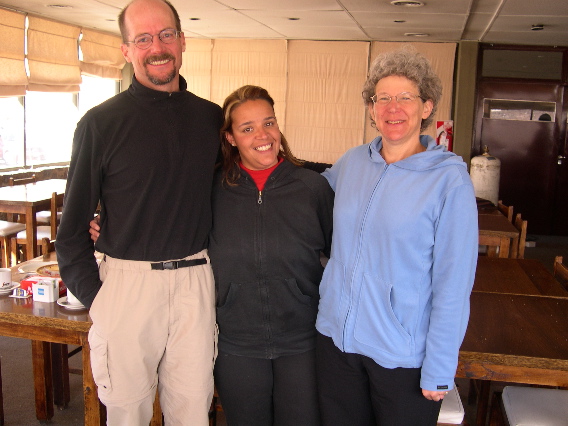
Snapping pictures on our last morning. This is Vanina, the manager without whom the stay would have been much shorter.
There was a followup picture that actually included the top of John's head, but I liked this one better.
Perhaps the one further thing that was quite unusual was the “torch run” that Penitentes does every Saturday night. After dark, all the ski instructors and patrollers carried flaming gasoline torches down the hill, complete with music. Quite the spectacle, particularly when a skier would start hot-dogging and “flame out” rather spectacularly.
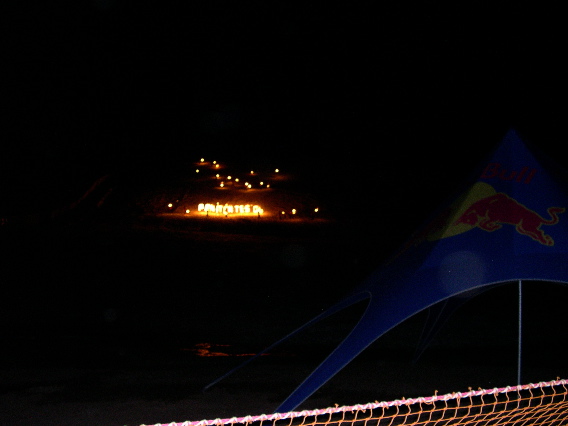
The last bajada antorcha of the season. The letters spell out Penitentes 06.
It took us a long time to get back to La Serena, but life soon settled down again. I am particularly happy with the way my class is going. My host had asked me to teach observational astronomy. But as this isn’t a regularly scheduled class, the students are apparently not getting official credit for it. They will be given some sort of participation certificate when it is over. I have to admit that I really like the fact that I am neither giving grades nor grading papers. We call the class Contando Fotones, or Counting Photons. [If you're really interested, we have a class website, but I am avoiding links to it so as to keep Google away from it. Please do not create any links to it. The first part of the address is www.dfuls.cl; the second part is /~astrovis] The only time that fits into the students’ schedule is 3:00 on Friday afternoons, and we typically go until about 6:30, occasionally longer. We always have a coffee and cookie break at about 4:30. Jaime, the first floor caretaker, brings us hot water and teacups.
I did lecture the first week, and for about an hour the second week, but since we have gotten IRAF going in their single computer lab, we have been basically doing lab work. Before class I write up both notes and exercises. I lecture for five or ten minutes, and get some help translating into Spanish for those who are confused. Then the students work through the notes and/or exercises, and I walk around the room and help them. Usually someone else helps also, either Rodolfo or Roberto Gamen. When we finish that exercise, I talk for another five or minutes, and we go on to the next exercise. It’s very relaxed, and I am enjoying the students. We have a good time helping each other with our English/Spanish. A few of them speak excellent English, a few speak very little, and most are in between. They are really very sweet!
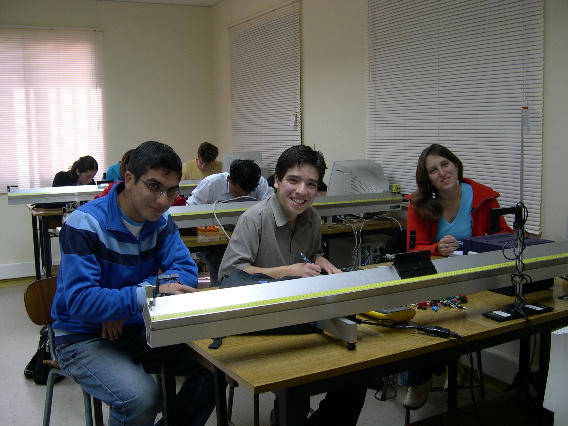
Logan, Leo and Yvonne smile for the camera. Note the seriously underequipped computer lab --
six slow PC's with bootlegged copies of Windows.
The class has settled down to about fourteen students. Most of them are undergraduates, although there are a couple who graduated just last semester (it is a nine-semester program) and one man who teaches at several different schools in town, and is working on a Master’s degree here. There are far more men than women in my class, although Rodolfo has told me that in Argentina about 40% of the astronomy students are women.
The department here arranged for the class to have a tour of Las Campanas observatory. Nidia Morrell gave the tour in Spanish, but John and I were the only “professors” on the bus that Saturday. It is a spectacular observatory, so of course we had a great time. All the students were very excited – it was sometimes difficult to get them to focus, as they were so busy taking pictures of each other with the telescopes and scenery as backdrops!

Nidia, the students and myself at Las Campanas with the giant Magellan telescopes as backdrop.
In other news, we finally bought bicycles after the first month. Apparently John is taller than most of the other men here, and we had to wait for a bike his size to come in. For reasons we don’t understand, we were unable to find used bicycles, and ended up buying new Treks (shucks). This has expanded our physical horizons considerably, especially for John. It also makes going to the university a lot faster, although I live in terror of the traffic. It's a good thing that they are mountain bikes, as the roads here are not very smooth.
About two weeks ago we took a tour of the Elqui Valley with a local travel agency. The town of La Serena is on the mouth of the Elqui river, and an intricate system of irrigation canals combined with drip irrigation allows an amazing number of crops to be grown in this really very dry place. Close to town there are fruit orchards, especially papayas, as well as vegetables. Farther up the valley they grow the grapes for pisco, a grape brandy which is the national drink of choice. (Apparently there is on ongoing controversy with Peru as to whether pisco originated in Peru or in Chile. The word on the street is that Peru actually has the high ground on this. But you didn't hear it from me.) Unlike the many wineries further south in Chile, this region has the right climate only for the sweeter grapes needed for pisco, not for wine grapes. Our tour included a visit to a Pisco factory, which included pisco tasting. Por supuesto. But the sight of the steep, absolutely arid hills with bright green vineyards creeping up the sides was impressive.
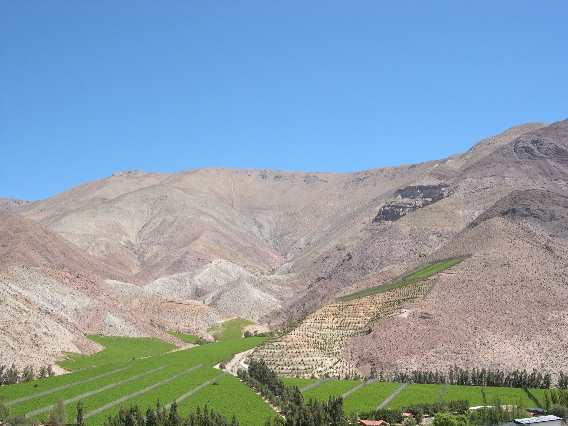
Vineyards near the town of Pisco Elqui
One of the interesting things here is the style of food. As any self-respecting Californian, the first time I came to Chile I expected the food to be similar to Mexican food. But it is not. Not at all. The best way to describe it would be bland meat and potatoes, or perhaps chicken and rice. The hot chilis from Mexico and Central America really do not show up, except in a single salsa called pebre which sometimes finds its way onto restaurant tables. Potatoes are extremely popular, as are avocados. Judging by what I see most of in the grocery, so are all kinds of dried beans and pasta for the poorer folk, and meat and sausage for the more wealthy. And this country has the most amazing sweet tooth. Cakes, cookies and jams are everywhere, and even "fresh juice" has sugar added to it. In order to find plain orange juice without sugar, it took a lot of label reading to discover a brand of "light" juice that had no added sugar. Most "light" products have nutra-sweet in them.
I should mention the Fiestas Patrias, the holidays that prompted the week closure of the university. This is apparently the biggest holiday of the year and is the celebration of Chilean independence, which they date from 1810. (Chile is already starting to celebrate their bicentennial; the swimming pool is closed next week for some Bicentennial Games.) The sales of red, white and blue banners and Chilean flags started weeks before the actual holiday. The Chilean equivalent of George Washington was Bernardo O'Higgins (I am not making this up), who was apparently the illegitimate son of an Irishman who served the Spaniards as Viceroy of Peru. O'Higgins was second in command to Argentina's liberator, Jose de San Martin.
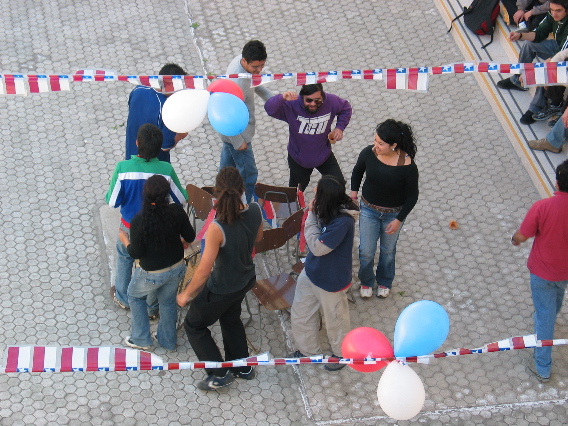
The students who started their holidays early (Thursday afternoon) in a very noisy manner just outside the window of my office.
These students are playing musical chairs, which apparently is much more fun when accompanied by salsa music and beer.
We are very slowly climbing up the learning curve on the language. Our vocabulary does seem to be increasing, but the real gains are in listening. John in particular is doing much better at understanding what is said to him. We try to listen to CNN Espanol (out of Atlanta!) for a bit in the evenings. I would say that I am at about the 20% level overall, although there are still some people who I cannot understand at all.
Most of you probably know that we lost our dog, Annie, about two weeks ago. She was still in Flagstaff; at the age of 16 she was not up for international adventures. In fact we were surprised that she lasted as long as she did. But as much as it was expected, her loss has still been a difficult adjustment.
Erin is adjusting to life in London for the year. For those of you who would like to keep up on her adventures, here is her blog. Meg is in Maine, working on a research project that involves analyzing snail shells from antique collections in science museums. We have bought plane tickets to bring them both here at Christmas. I can hardly wait.
We hope that this news finds you all well and happy!
love,
Kathy and John
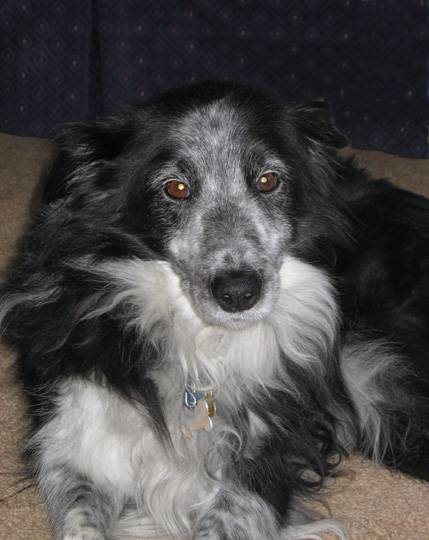
Annie Eastwood, 1990 - 2006