Letter from Chile Number One
15 September 2006
We have now been in Chile for exactly four weeks, and are really enjoying ourselves. Although we haven’t done any touring, just buying groceries is an adventure. All the people that we have met are helpful and friendly, the weather has been mostly fine, and our little house is comfortable.
If you are into Google Earth, try looking at La Serena Chile. This town of 160,000 people is on a small bay. The same-size town of Coquimbo is very close, and has a real port on the other side of its peninsula. We do not have a car, and have been getting good exercise walking around town. Our house is about an hour walk from the beach, so I have walked there just once. However we are buying bicycles, and hope to expand our explorations.
I am visiting at the University of La Serena. My host, Rodolfo Barbá, has been very good to us. He arranged a meeting between John and the economics department, and that department received John with welcome arms. He has an office all to himself! (I share Rodolfo’s office.)
Perhaps the single thing that is most different is the expected method of greeting people. For women-women and men-men greetings, a kiss on the cheek is expected. I’m not used to kissing my office-mate, my students, and perfect strangers, but hey, I’m getting used to it. I was very impressed when meeting12-year old Nico Garcia, whose father is an astronomer at Gemini, as he gravely and politely kissed me on the cheek. Also, the daily schedule is much different here. People are expected to go home for a two-hour lunch break. The stores are generally closed between 2:00 and 4:00. Restaurants do not start serving dinner until 8:00.
Chile is not a third-world country and has the best economy in South America. There is still poverty, however, and often the streets are rather dirty. Many roads and sidewalks are still dirt. The climate is dusty as well, and since our house has huge gaps around the doors, keeping the house clean inside is a constant battle. Dogs are very popular here, both inside and outside the yards. There are a fair number of stray dogs. However, they all seem very laid back, spend most of their time sleeping, and do not seem scrawny or ill-fed.
Some things are much cheaper here than in the U.S. (fruits and vegetables especially), some things are about the same (broad band internet to the house), but some things are more expensive (car rentals, peanut butter). The fresh produce has been probably the most fun thing for me. There is an open-air market four mornings per week, and I have been experimenting. One night I served up a lovely melon that looked like a honeydew. After my first bite I said “Oh, this isn’t very good. It’s not sweet.” John said “I think it’s a squash.” And sure enough, after we cooked it up it had the texture of a spaghetti squash. It just didn’t look like one!!
The most difficult time we have had was the first week. La Serena has a moderate maritime climate, and is quite lovely when the sun is out. However, when it is cloudy it can feel quite cold. We arrived at the end of the winter here, and the first week was cloudy and cold. We were comfortable when out walking around, but miserably cold inside the house or office. (We felt like we were camping, wearing our hats and huddling on the couch under a blanket!) It turns out that Chileans don’t heat their houses or schools! The director of the Chilean Fulbright Commission told me that even in the far south they don’t heat the buildings, and that there sometimes students and teachers go to school wearing parkas inside. She’s not sure why – she said that past poverty might be part of the reason, but that also she thinks that Chileans do not believe that they have winter! Wow...a whole country in denial. At any rate, we finally bought a little space heater and have been much happier.
Our house is in a neat, older neighborhood of small, cinder-block houses. Apparently the area once belonged to the military; at least that was the explanation given for the flagpole in the front of every yard. In the photo, note the fences, bars over the windows, and trash-stand. Virtually every house in town is inside a locked gate with bars over every window. Every entrance to our house has at least two locks between it and the outside world, and some have three. Since every single lock has a different key, it’s a bit difficult to keep track! And we’ve actually deciding that keeping the gate locked is a good idea – it keeps the fish-guy from knocking on our door and trying to sell us fish from his bicycle.
People keep telling us to keep everything locked. I’ve even seen a couple of fences with broken glass glued to the top edge to keep people from going over. And in the local grocery I’ve often seen private security guards hovering around the entrance. But we have not seen any problems.
The trash, usually in small grocery-store plastic bags, gets put up in the air in the small trash-stand. The unfortunate few who don’t have trash-stands hang theirs from a tree, or as a last resort leave it on the ground (which makes it subject to stray dogs). Our neighbor, Sr Torres, finally explained to us that the trash is picked up Tuesday, Thursday, and Saturday evenings at about 11:00 pm. Go figure. In a similar vein, the three cycles on my washing machine are Fuzzy, Rapido, and Jeans. (?)
And although the neighborhood is neat, I wouldn’t call it quiet! In addition to the afore-mentioned fish-guy, there are trucks (from competing companies) that sell gas (propane?) that cruise the streets daily, ringing their bells at least several times per day. One morning a man walked by announcing his presence in a very loud sing-song; we couldn’t understand him, but he was pulling a small hand-truck that had a picture of scissors on it, so we figure he was sharpening things. Boy, did the dogs bark at that one! And the very first morning we were here, I made the mistake of going to the gate (I thought it was Leonor) and was trapped by four Jehovah’s Witnesses, one of whom spoke perfect English. Some things never change.
The language continues to elude us. John learned the difference between four (cuatro) and one fourth (un cuarto) when ordering roasted chicken and french fries (the Chilean version of fast food.) Instead of a fourth of chicken (breast portion), he ended up with four breast portions. But although we are getting better at speaking, we are having a very hard time understanding people. They not only speak very fast, but the Chilean accent is difficult. They not only drop s’s off the end of words, they often drop them out of the middle. The word “mismos” in this case becomes “mimo”. So we are still very much on the uphill learning curve on this one.
Stay tuned, Kathy and John
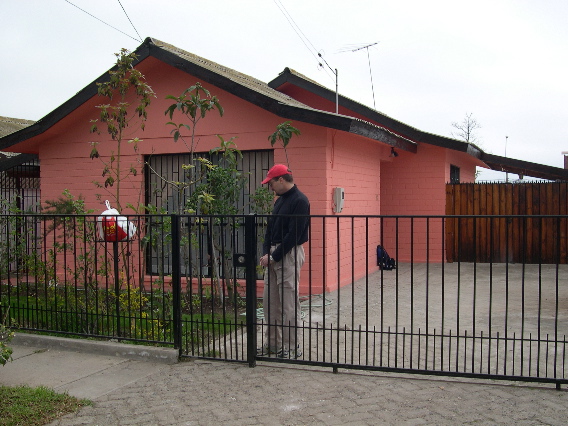
John in the front yard of our casita. You can’t quite see the flagpole, but you can see the trash in the white shopping bag. From our backyard I can catch a glimpse of the sea.
|
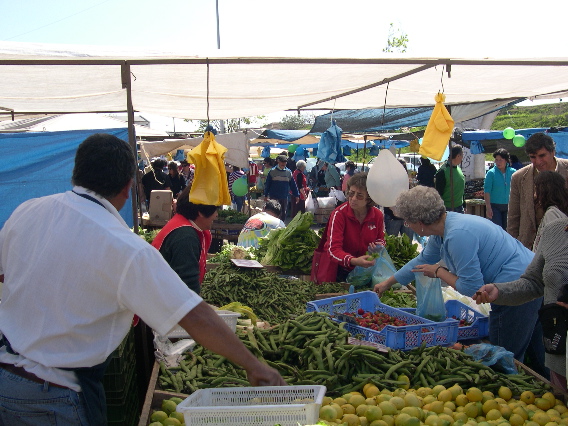
Kathy shopping for strawberries and sugar snap peas at the feria.
|

View on the beach looking towards Coquimbo.
|
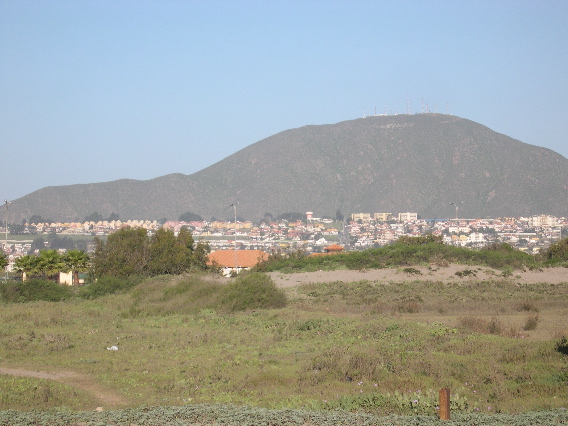
View from the beach looking back towards town. Our neighborhood is close to the top edge of houses on the left.
|
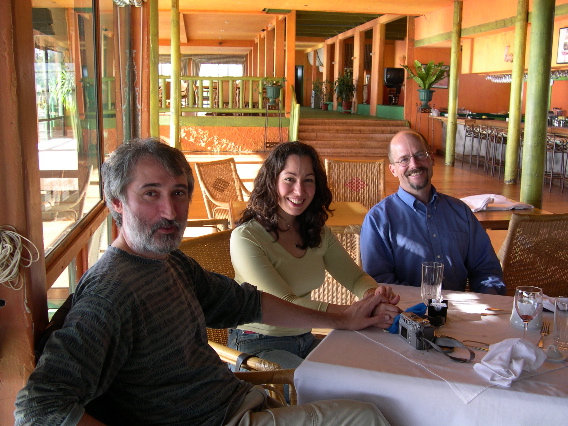
My host Rodolfo, his wife Julia, and John in a fancy seaside restaurant down the coast a bit. We offered to buy them afternoon-dinner as I still don’t have enough kitchen equipment to cook with, and they not only gave a party for us at their house on our first Saturday, but also took us to lunch the day we arrived. Rodolfo and Julia are both from Argentina, not Chile. Note John’s “Bruce Willis” haircut, which was the result of a slight miscommunication with the barber.
|
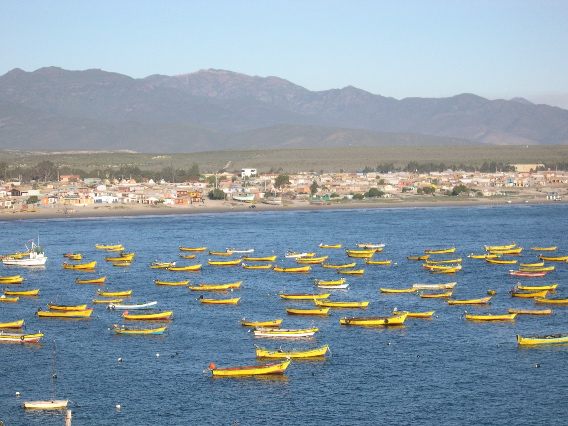
The fishing boats in the town of Tongoy, that same afternoon.
|